


Audrey O’Mahony
Talent & Organisation Lead, UK and Ireland, Accenture

Wendy Walsh
Talent & Organisation Lead, Accenture in Ireland
Embracing change: Why reskilling and openness matter in the age of agentic AI
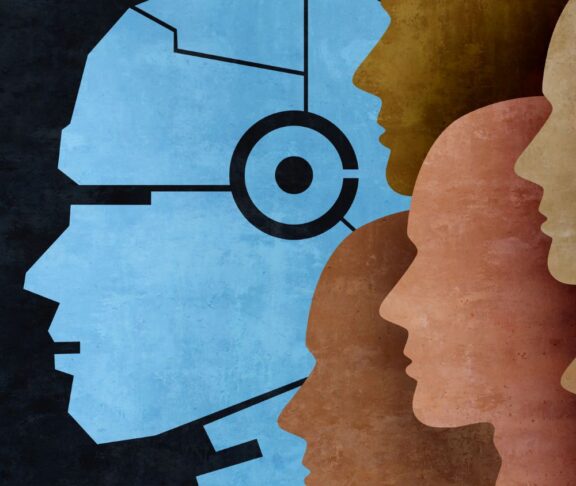
Thanks to artificial intelligence (AI), workplaces will enter a new era of intelligence. Audrey O’Mahony, Talent & Organisation Lead at professional services company Accenture, doesn’t downplay its challenges, but insists organisations must be prepared to embrace them. She also wants leaders to recognise the big picture business value of AI, specifically agentic AI (autonomous systems that require minimal human intervention) and content-creating Gen AI.
“It can’t simply be about improving efficiency or reducing costs,” she says. “Instead, it’s a huge opportunity to think differently and reimagine how to create more high-value work using agentic or Gen AI capabilities.”
Wendy Walsh, Talent & Organisation Lead, agrees. She sees AI as “a new task-level disruptor” and thinks its immediate impact will be to drive process, therefore job redesign. While machines take care of mundane and language-heavy tasks, the human workforce will have more time to focus on judgment calls and client relationships and ultimately drive more top-line value.
Building a positive culture with a clear narrative
To prepare, leaders should tell their people about what they’re trying to achieve with AI and the impact it’ll have on them. Being open and transparent with consistent messaging will help reduce employee anxiety, build trust and create an environment where staff where staff can experiment with AI. Crucially, they must have permission for, and the opportunity to, experiment with and learn how to work with and alongside new technologies.
Many of Accenture’s clients — from financial services organisations to technology companies to government — are starting to embrace agentic and Gen AI. “For example, we’ve seen organisations use Gen AI capabilities to optimise data quality, better enabling complex technology programmes,” says O’Mahony. “And now we are helping our clients design how multi-agent capability can transform everything from customer experience to sales and support, pricing and product innovation as well of course as all middle and back-office activity.”
A challenge of scaling agentic is ensuring that leaders understand its capabilities and how best to deploy it. “We’re spending a lot of time supporting clients with the reskilling agenda — both the workforce and also C-suite leaders”, says O’Mahony. “They know they need to understand the technology and what they must do to accelerate their digital infrastructure to enable deployment. They also need to understand how it’ll impact the employee experience and transform consumer behaviour.”
To successfully scale AI adoption, the reskilling of frontline employees is vital because they’ll be at the centre of it.
Importance of sound AI governance
To successfully scale AI adoption, the reskilling of frontline employees is vital because they’ll be at the centre of it. “However, while we’re seeing recognition of this importance, there’s more to be done to ensure the workforce reskilling agenda is a priority,” admits O’Mahony. “The good news is, because of digital tech and government supports and interventions, training is more readily accessible, but getting to apply learning in roles is what’s actually key.”
Reskilling must be a priority, says Walsh, who says it’s critical for responsible AI deployment and use. “AI governance will become as important as the technology itself,” she says. “The EU AI Act is putting companies under pressure to be AI literate, which means everyone must be trained and empowered to understand what the tools can do. For example, Accenture has made sure it’s been walking the AI walk with mandatory staff training. “I’m always thinking about the AI agents I can create,” says Walsh. “As leaders, we have to embrace this because the next generation has already come to expect it.”
Organisations need to think of agentic capability not as a ‘bolt-on’ tool, but as an entirely new workforce. “But it’s not a workforce that’s a silver bullet,” stresses O’Mahony. “It’s a workforce with imperfections that’s learning and growing, so designing processes with a human in the loop is critical. Ultimately, it’s about humans operating with AI to bring ongoing and enduring value to a business. The Irish workforce is a proven pioneer in technology and digital, and this is the next wave of opportunity to capitalise on.
