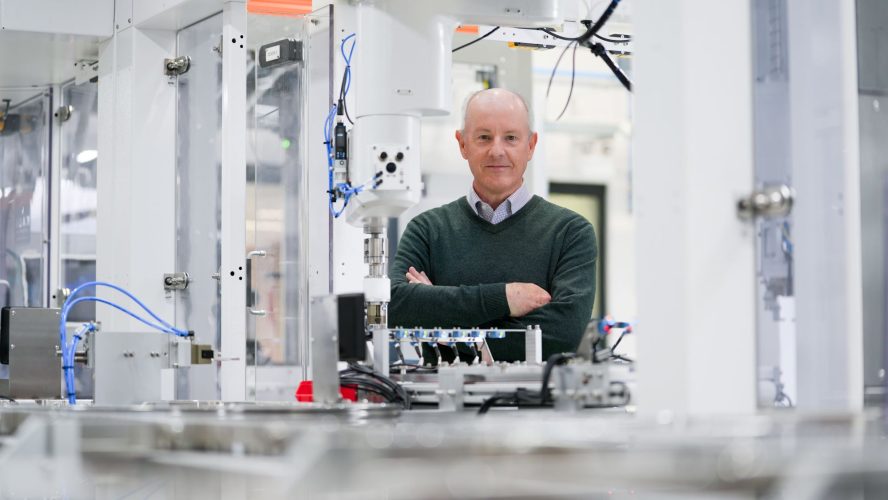


Domhnall Carroll
CEO, Digital Manufacturing Ireland
As Ireland deepens its position as a global manufacturing leader, combining emerging technologies with an empowered, agile, future-ready workforce is proving to be the key to sustainable growth.
Technology is changing the manufacturing landscape rapidly. The arrival of tools such as artificial intelligence (AI), advanced robots, vision systems and the Internet of Things (IoT) has meant that manufacturers need to adapt quickly and ensure they have the latest cutting-edge innovations at their disposal to avoid falling behind. However, investing in the right talent should go hand-in-hand with investing in the right technology, explains Domhnall Carroll, CEO of Digital Manufacturing Ireland (DMI), an industry-led organisation that helps drive digital technology adoption across Irish-based manufacturing.
In a demanding environment, maintaining focus on the human element is a key opportunity to unlock the full value of new technologies. This is where the concept of ‘human-in-the-loop’ becomes essential, ensuring that people remain actively involved in decision-making, oversight and continuous improvement. Human-in-the-loop systems allow manufacturers to blend machine efficiency with human judgement, supporting safer, more adaptable and more reliable operations.
When manufacturers develop technology roadmaps to optimise and enhance operations, sometimes, the people aspect is overlooked. “It’s a challenge we understand,” says Carroll. “Ireland is uniquely positioned to lead in advanced manufacturing, and we’re here to help the continuation of this advancement by creating roadmaps that recognise the importance of people.”
Enabling workforces to adopt new technologies
“We’re embedding future skills requirements into our technology roadmaps,” explains Carroll. We empower manufacturers to ask the right questions: ‘What capabilities will our workforce need? How can we prepare our teams to maximise the value of new technology?”
Manufacturers are increasingly finding that it’s not only advanced technologies, such as AI, that require workforce upskilling, notes Carroll. Training is equally important when a company makes more foundational technological changes, such as transitioning from paper-based systems to digital ones.
“Manufacturing is, essentially, a physical activity,” says Carroll. “So, any change takes on a different, slower cadence than it would in, for instance, insurance companies or financial services firms. But if your role as a manufacturer is to physically make 100,000 products and get them out the door by the end of the month, there’s a temptation to view upskilling in, say, AI as a distraction from your day job. What we’re saying at DMI is: we understand that. But also, while you might not need those skills right now, you should be ready for when you do because that day will arrive.”
Helping manufacturers understand the skills they need
With technology evolving so quickly, there’s a tremendous opportunity to stay ahead of the curve and understand which skills will be essential both now and in the future.
This creates an exciting space for deeper partnerships. DMI works closely with clients to transform existing data into actionable insights, while empowering manufacturing leaders to make informed decisions about their workforce development.
Another valuable dimension in adopting new skills is addressing workforce concerns about their evolving roles. Successful upskilling focuses on the enhancement and evolution of roles, not the replacement.The focus is to build digital capability in an accessible and empowering way, linking technology adoption directly to business outcomes and career advancement.
There is a strong need for companies to identify where robots and automation add the most value – and where they don’t. When machines are introduced, they should support people, rather than the other way around.“That may seem like a small detail,” says Carroll, “But it’s an important one because putting people in control of processes and outcomes is key for the culture of any organisation.”
Human-in-the-loop systems allow manufacturers to blend machine efficiency with
human judgement, supporting safer, more adaptable and more reliable operations.
Importance of microlearning in manufacturing
Of course, in ultra-busy manufacturing environments, it’s one thing to talk about the importance of upskilling staff to use the latest technology. It’s quite another to find the time to do it successfully.
“It sometimes happens in manufacturing organisations that workforce training is planned but then has to go by the wayside when a big order comes in,” says Carroll. “As a result, a gap opens between those employees who have the time to step out of their day job for training and those employees who don’t.” This creates a dilemma: manufacturers need to upskill their people while continuing day-to-day operations. Finding that balance is the challenge, notes Carroll.
“This presents an interesting dynamic: how do we ensure everyone has access to upskilling opportunities, regardless of their role?” says Carroll. “As a manufacturer, the opportunity is to view upskilling as a strategic investment that is woven into your operational rhythm, not separate from it. What we’re doing at DMI is helping manufacturers design flexible training approaches that work for all employees, ensuring everyone can develop new skills while keeping operations running smoothly.”
Modern manufacturing opens exciting possibilities to upskill the workforce in ways that fit seamlessly into operational demands. One approach is DMI’s newly launched Manufacturing Skills Platform, a flexible training platform developed by industry, for industry, addressing real-world manufacturing challenges. The platform delivers role-specific microlearning content online, directly to the workforce. “The great thing about microlearning is that staff don’t have to take a day out to sit in a training room,” says Carroll. “They can do it in multiple 10-minute sessions, at their point of work, whenever it fits into production schedules. It’s a way for everyone to gain new knowledge.”
Maintaining Ireland’s place as a leading manufacturing hub
Various factors have made Ireland a hub for advanced manufacturing over the years. Many site leaders have put digital transformation at the forefront of their strategies, plus the country’s manufacturing supply chain is strong.
Additionally, the Irish workforce demonstrates remarkable adaptability and agility. “It’s a culture where people support each other and work well together,” says Carroll. “Geographically, we’re quite small, which helps build a strong ecosystem where networking opportunities are very high. And our manufacturers are very well qualified, with high rates of frontline workers having a third-level education. The skills level here means that people are more open to adopting new technologies, which in turn fosters a culture of continuous improvement and collaboration. It’s a workforce that’s enabled for new technology.”
Successful upskilling focuses on the enhancement and evolution of roles, not the replacement.
What steps can manufacturers take in the next six months
Ireland is poised to seize a significant moment. The world has evolved dramatically with the introduction of AI.Over the next six months, Irish manufacturers can build foundational digital literacy skills across their organisations. This empowers manufacturers to support AI adoption through accessible digital skills development, and at the same time scale successful data-driven initiatives across their teams, aligning workforce development with the pace of technological change. Manufacturers who embrace change today can unlock new possibilities and position themselves at the forefront of Ireland’s evolving manufacturing landscape.
Concrete actions taken today will open doors for Irish manufacturers leading into the future, presenting them with the space to explore how emerging technologies and the development of new skills can improve their global competitiveness. “While long-term strategic planning remains important, we’re committed to showcasing the incremental changes that will deliver tangible results for companies immediately,” says Carroll.
