

Graham Brennan
Head of Vehicle Standards, RSA
Autonomous vehicles, or driverless or self-driving vehicles, can drive without human input and could be a game-changer towards achieving our vision of zero road fatalities and serious injuries.
Most road traffic collisions are caused by human behaviour, like dangerous driving, driving under the influence of drugs or alcohol, falling asleep at the wheel, breaking the speed limit and mobile phone use. Standard measures to curb these behaviours, like education and awareness campaigns, enforcement, fines and penalty points, are essential, but what if you could remove these behaviours entirely?
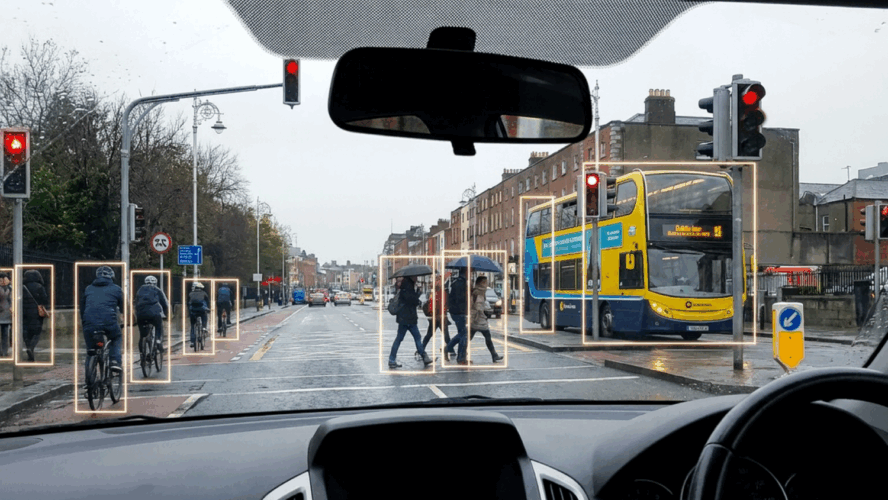
For a vehicle to drive itself, it must first see and interpret each item in its environment. It uses a pre-trained neural network to scan the image of the scene ahead and classify each object (e.g. person, car, traffic light) and predict its possible movement. Graphical processing units allow thousands of objects to be analysed in parallel. This neural analysis scan happens at 30 frames a second across multiple sensors. For instance, the Waymo robotaxi uses 13 cameras, six radars and four lidars! So, it’s fair to say that an autonomous vehicle needs a lot of computing power.
From driver assistance to full automation
The Society of Automotive Engineers introduced a scale to express the level of automated driving capability for a vehicle. Level 1 and 2 means that the vehicle assists with some driving functions, such as lane positioning and adaptive cruise control. These systems are collectively referred to as Advanced Driver Assistance Systems (ADAS), many of which are mandatory for new vehicles. Level 2 capable vehicles are common in Ireland today; however, the driver must remain alert and fully engaged at all times.
Level 3 technology is the first point where we see vehicles operating on their own without requiring the driver to be fully engaged with the vehicle for specific operating conditions (eg. on the motorway). The driver may read a book or look at a screen, but remain available to take over. Such vehicles are already available in Germany.
For a vehicle to drive itself, it must first see and interpret each item in its environment
Level 4 technology goes further and doesn’t require a driver to be physically present, such as Waymo or Tesla robotaxi services available in the US. Notably, Level 4 technology demonstrations are dominated by large IT firms. They see business potential by removing the need for car ownership through robotaxi services, and with a shortage of truck drivers, there’s sizeable potential to offer non-stop 24-hour-a-day driverless freight services. Waymo and insurance company Swiss Re claim that following 25 million miles of driving, Waymo vehicles offer a 90% reduction in claims related to human-operated vehicles. A Waymo vehicle was involved in one fatal collision in 2025, but it was empty and stationary at the time and Waymo was not held liable for the multi-car collision.
Finally, we arrive at the holy grail: Level 5 is a fully automated (or autonomous) vehicle expected to operate in all environments without even a remote supervisor for backup.This may be years away, but it will emerge naturally as the patchwork of cities and routes where Level 4 is approved to operate steadily expands.
What about us?
Ireland is developing an industrial edge in this technology, west of the Shannon, which we must nurture. We must prepare ourselves for this march towards automation and ensure society is fully informed. Both drivers and enforcement agencies must be clear about the law concerning the use of automated vehicles, which will require consideration of our legal definition of driver and driving. Lastly, we must consider the need to allow these vehicles to be tested and trained safely on Irish roads, as is the case in most of the EU, to ensure that the highest level of safety benefit is obtained for Ireland.
